

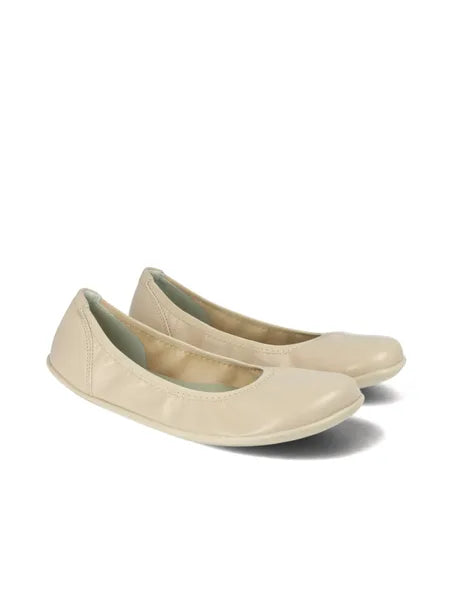

I spent fifteen years in steel-capped work boots. Eight, sometimes ten hours a day, five or six days a week. And for most of those years, I thought the aching feet, the stiff ankles, and the knackered knees were just part of the job. Just part of getting older. That's what every bloke on site told me. "Wait till you hit forty, Dan. It gets worse."
Except it wasn't age. It was my shoes.
I'm Daniel. I run Barefoot Brit Shop with my partner Brittany and our team. I've written before about the moment I finally gave my head a wobble and swapped my conventional boots for barefoot shoes. But this article is specifically about men. Because in my experience, men are the worst when it comes to foot health. We ignore pain. We push through. We buy the same stiff, narrow shoes we've always worn and wonder why our feet, knees, and backs are getting worse every year.
If that sounds familiar, keep reading. Because the fix is simpler than you think, and it doesn't involve giving up smart shoes or work boots.
Why men's feet are in worse shape than they think
Here's the thing I've noticed after years of fitting men's shoes: most men have no idea their feet are damaged. They'll tell me their feet are "fine" while standing in front of me with toes that curl inward, bunions forming on both sides, and arches that have completely collapsed. They've been in the same shaped shoe for so long that the damage looks normal to them.
Men are also far less likely to question their footwear. Women's shoes get a lot of criticism for being narrow and restrictive, and rightly so. But men's shoes are just as bad, if not worse in some ways. The difference is that men's shoes look practical. A leather Derby shoe or a chunky trainer looks like it should be good for your feet. It looks sturdy. It looks supportive. But looks are deceiving.

That photo above is me, holding a boot I wore for years. See the way the sole has separated from the toe? That's because the toe box was so narrow that my toes were constantly pressing against the front and sides of the boot, bending the structure out of shape from the inside. My toes were doing the same thing. Pressing, curling, compressing, for hours every single day.
What conventional shoes do to men's feet
The damage from stiff, narrow shoes builds up slowly. You don't notice it day to day. But over months and years, the effects are hard to ignore. Here are the three problems I see most often in men:
Bunions and toe compression. A narrow, tapered toe box forces the big toe inward. Over time, the joint at the base of the big toe protrudes and becomes painful. That's a bunion. Men's dress shoes and trainers are some of the worst offenders because the toe box narrows to a point, and men's feet are often wider than women's to begin with. Wider feet in narrower shoes means more compression, faster.
Plantar fasciitis and heel pain. Most conventional shoes have a raised heel. Even trainers and casual shoes often have a 10-15mm heel-to-toe drop. This shifts your weight forward, puts constant tension on the plantar fascia (the band of tissue under your foot), and weakens the Achilles tendon. Men who spend all day in heeled shoes and then wonder why their heels burn first thing in the morning are feeling the cumulative effect of years of this tension.
Weak foot muscles and collapsed arches. A thick, stiff sole acts like a splint. It does the work your foot muscles are supposed to do. Over time, those muscles weaken and the arch drops. This is why men who've worn supportive, cushioned shoes for decades often find their feet hurt more, not less, when they walk barefoot. Their feet have lost the strength to support themselves.
What does wide fit mean for men's shoes?
"Wide fit" doesn't just mean a bit of extra room. True wide fit barefoot shoes have three features, and all three matter:

A wide, foot-shaped toe box. The front of the shoe should be shaped like an actual foot: widest at the toes, not at the ball. When you take the shoe off and look at the outline, it should look like a foot print, not a pointed arrow. This is the single most important feature because it's what stops toes from compressing. Your toes should be able to splay naturally inside the shoe, the same way they do when you're barefoot.
A flat, zero-drop sole. The heel and the toe should be at exactly the same height. No raised heel, no platform, no "drop". This lets your foot sit flat, the way it's designed to, and keeps your posture aligned. For men who've been in heeled shoes for years, the switch to zero-drop can feel strange at first, but within a couple of weeks, most men report less knee and lower back pain. That's because a raised heel tilts the entire body forward, and your knees and back compensate for years.
A thin, flexible sole. The sole should be thin enough that you can feel the ground through it, and flexible enough that you can twist and bend the shoe with your hands. This isn't about being minimalist for the sake of it. It's about letting your foot muscles work. Every step in a stiff sole is a step where your foot muscles switch off. A flexible sole keeps them engaged, building strength back into feet that have been immobilised for years.
If you want to see our full range, head over to our men's wide fit barefoot shoes page. It breaks everything down by style, fit, and use case.
But what about work boots and office shoes?
This is the question I get more than any other from men. "I can't wear barefoot shoes to work." Or: "I need steel toe caps." Or: "My office requires proper dress shoes."
I get it. I spent years on building sites. I know what it's like to need safety footwear. But here's what's changed: the barefoot shoe industry has caught up. You can now get barefoot dress shoes that look indistinguishable from a conventional Derby or Oxford. You can get barefoot safety boots with steel toe caps and wide toe boxes. The only visible difference from the outside is that the toe box is slightly wider, and the sole is thinner. Most people will never notice.

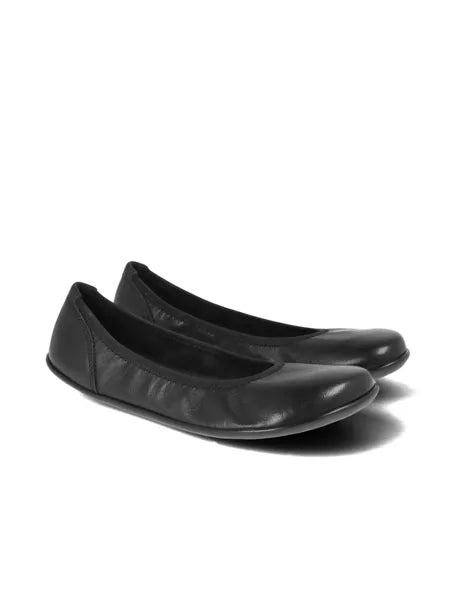
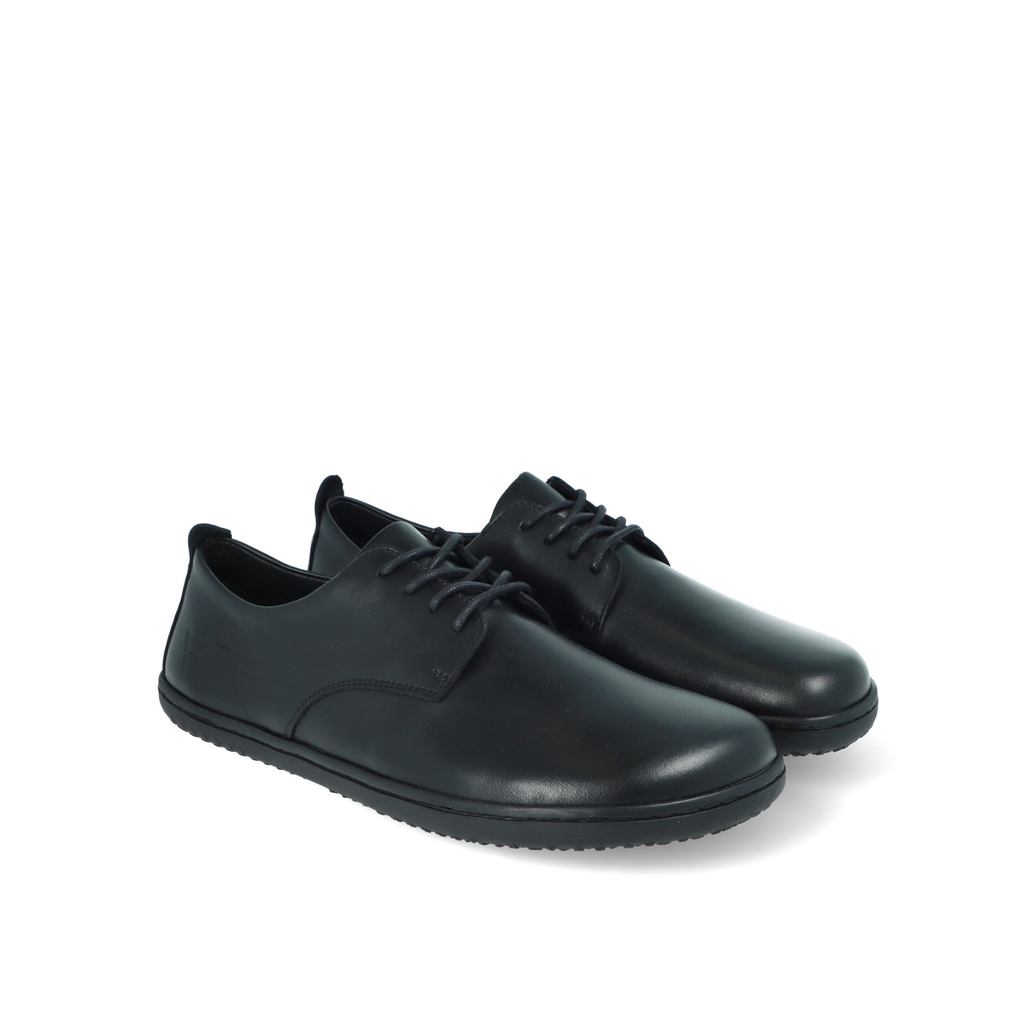
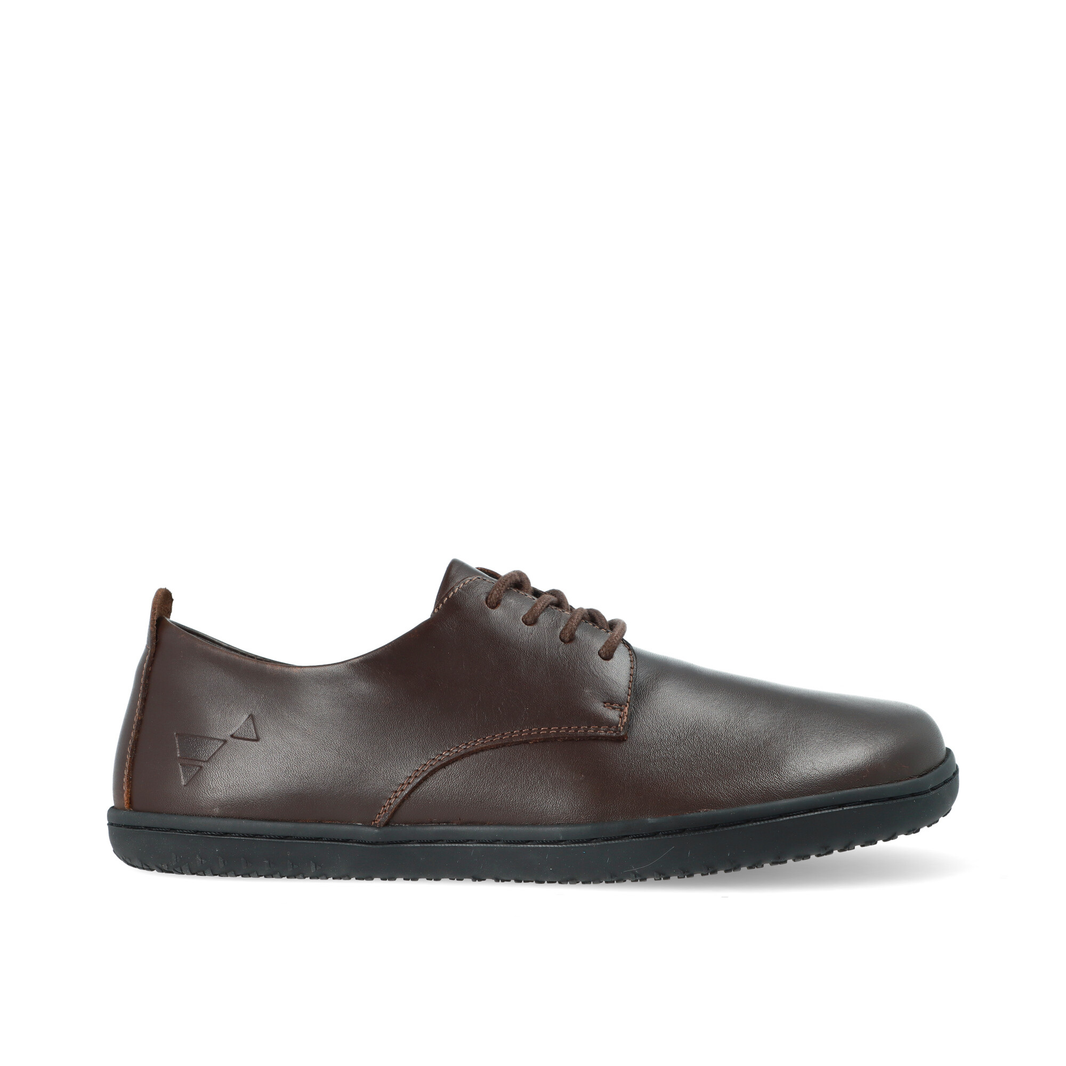
Those shoes above are barefoot office shoes. Wide toe box, zero-drop sole, flexible construction. From the outside, they look like normal leather dress shoes. Nobody at the office would know the difference unless you told them.
If you need safety boots for work, we've written a whole guide to barefoot work boots and office shoes that covers specific recommendations for both environments. The key point is this: you don't have to choose between protecting your feet on site and protecting your foot health.
How much room do men's feet need?
Unlike children, whose feet are still growing, adults need comfort room rather than growing room. The rule for men is 0.8 to 1.2cm of space beyond your longest toe. That's enough room for your toes to splay and move without the shoe feeling loose.
Here's how to measure properly:
- Measure both feet. One is usually slightly longer. Size to the longer foot.
- Measure in the late afternoon or evening. Feet swell during the day, so an afternoon measurement gives you the largest foot size and ensures the shoe won't feel tight by end of day.
- Stand up while you measure. The foot spreads and elongates under body weight, so a standing measurement is more accurate than a sitting one.
- Add 0.8 to 1.2cm to your raw foot length to get your target insole length.
We've put together a full step-by-step foot measuring guide with photos. Every product on our site lists the actual insole length, so once you've got your measurement, you can match it directly to the shoe. No guessing, no "I'm usually a 10 so I'll order a 10." Measure the foot, match the number.
If you're new to barefoot shoes, it's also worth reading our 5 quick tips for starting to wear barefoot shoes. The transition for men can take a bit longer than for kids, especially if you've been in stiff shoes for decades. Your foot muscles need time to wake back up. Start with a few hours a day and build from there.
Our pick of men's wide fit barefoot shoes
These are some of the most popular shoes from our men's range. All of them have a wide toe box, a zero-drop sole, and a flexible design, and every listing includes the insole length so you can match it to your measurement.


Looking for something specific? We have dedicated collections for men's barefoot trainers, men's barefoot office shoes, men's barefoot sandals, and men's barefoot boots. Or browse the full men's barefoot shoes collection to see everything in one place.
Common questions about men's wide fit shoes
Do barefoot shoes look weird?
Not any more. The early barefoot shoes did look unusual, and that reputation has stuck. But modern barefoot shoes are designed to look like conventional shoes. Our dress shoes look like dress shoes. Our trainers look like trainers. The wide toe box is slightly more rounded than a conventional shoe, but it's not obvious unless you're looking for it. Most men who switch find that nobody notices.
I have plantar fasciitis. Can barefoot shoes help?
Many men report improvement after switching to barefoot shoes, but it depends on the severity and the transition. Barefoot shoes strengthen the foot muscles and remove the raised heel that puts constant tension on the plantar fascia. However, if you've been in supportive shoes for years, you need to transition gradually. Start with a few hours a day. If you have active, severe pain, talk to a podiatrist first and consider a transitional shoe with a small heel drop before going fully zero-drop.
Can I wear barefoot shoes all day at work?
Yes, once your feet have adapted. The transition period varies, but most men are comfortably wearing barefoot shoes all day within two to four weeks. If you're on your feet all day in a physical job, start by wearing them for half the shift and switching to your old shoes for the second half. Build up gradually. Your feet need time to rebuild the muscle strength that years of stiff shoes have taken away.
I have wide feet. Will barefoot shoes fit me?
Barefoot shoes are inherently wider than conventional shoes because they're shaped like a real foot. If you've always needed "wide fit" versions of normal shoes, you'll likely find that standard barefoot shoes fit comfortably. Several of our brands also offer specifically wider lasts. Check the insole length and width measurements on each product page.
What about men with large feet?
Our men's range goes up to EU 48 in some styles. Sizes vary by brand, so check the specific size guide on each product. The key is always the insole length: measure your foot, add 0.8 to 1.2cm, and match that number to the shoe.
Your foot pain isn't just "getting older." It's years of the wrong shoes. The fix starts with the right pair.
Shop men's wide fit barefoot shoesI'll be straight with you. I wasted years thinking my foot pain was just part of the job. Stiff boots, narrow trainers, heeled shoes. I wore them all and I paid for it. My toes curled, my arches dropped, and my knees ached every morning. It took me far too long to realise that the shoes I trusted were the thing causing the damage.
If you're on the fence, measure your feet, find the right size, and try a pair. Give it two weeks. You'll feel the difference. Not because barefoot shoes are magic, but because they let your feet do what they were built to do. And men's feet, once they're given the room, are remarkably good at fixing themselves.
Related reading and useful links:
- Wide fit barefoot shoes for men: our full men's range with size guides
- How to measure your feet: step-by-step guide with photos
- Why BarefootDan finally gave his head a wobble: Daniel's full journey from sceptic to convert
- Barefoot work boots and office shoes guide: specific recommendations for work and formal settings
- Why barefoot shoes are better than conventional shoes: the full comparison
- 5 quick tips for starting barefoot shoes: what to expect during the transition
- All men's barefoot shoes: browse the full collection
Leave a comment